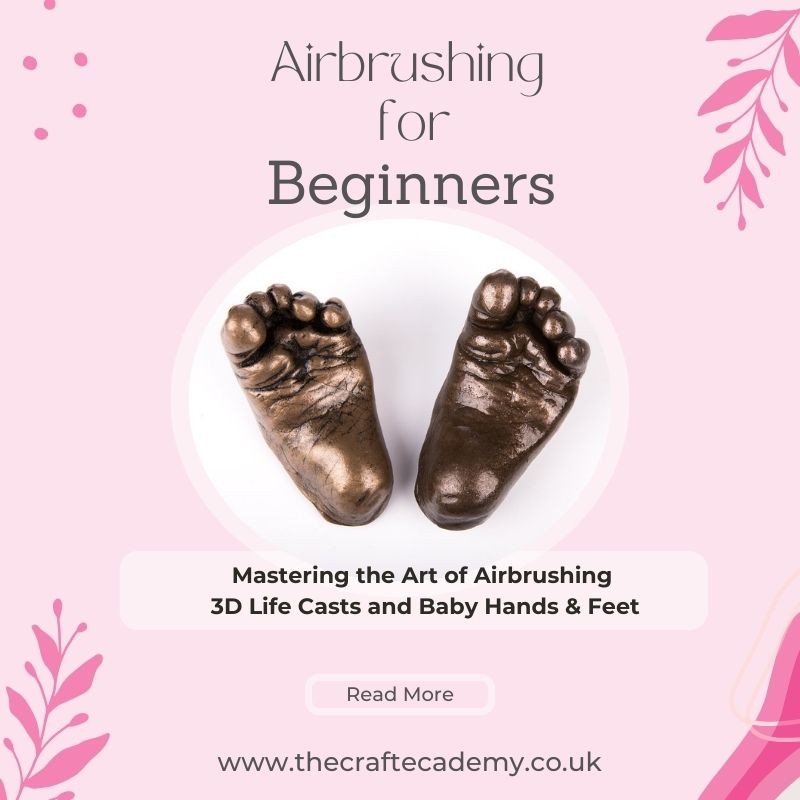

Mastering the Art of Airbrushing 3D Life Casts and Baby Hands & Feet
Introduction:
Airbrushing has become a popular technique in the world of life casting, offering a unique and precise way to add vibrant colors and intricate details to three-dimensional casts. In this comprehensive guide, we will explore the process of airbrushing your life-casting projects and 3D casts of baby hands and feet, covering everything from choosing the right equipment to troubleshooting common problems.
The first thing that I want to say about Air-brushing 3D Baby Hand and Foot Casts and other small Life Casting Projects is that it is a personal choice. There is no right or wrong way to paint your baby casts, so long as the plaster has been left to thoroughly dry before painting and appropriately primed and sealed.
From my own personal perspective, I prefer hand-painting by priming with fluid acrylic paint, before applying my favorite brand of gilders wax or paste and applying a matt or gloss UV protector and sealer.
I prefer this approach, because applying a metallic paste over a primed surface, allows for the creation of a faux-metal antiqued finish that uniquely highlights and accentuates all the intricate detail. This method, involving hand painting and waxing, offers a personal high-quality finish. However, it's essential to note that this is subjective, and there's no definitive right or wrong way. If your goal is to attain a seamlessly smooth, silky finish for your 3D baby casts, air-brushing might be the ideal choice.
Advantages:
The primary benefit of airbrushing lies in its ability to eliminate brush marks. However, when working on smaller objects like 3D Baby Casts and following the guidelines from my Life Casting Courses, this concern is mitigated, as I advocate against directly applying paints and metallic lusters with a brush in these instances.
Airbrushing does however present advantages, particularly when working on expansive projects like torso casts or pregnant belly casts. The likelihood of visible brush marks is higher on larger-scale life casts when using traditional painting methods. However, employing the hand-painting techniques showcased in my Life-casting courses effectively addresses this concern.
Regardless, here are a few advantages of air-brushing in general:
Disadvantages:
As I've already said, the main disadvantage of air-brushing 3D baby Casts and other smaller-scale life-casting projects is that it is harder to accentuate the fine detail and achieve the faux-antiqued metal finish that is possible with hand-painting and waxing. In addition, air-brushing also has the following disadvantages:
1. What Airbrush to Use:
Choose an Airbrush Kit with a Compressor that comes equipped with all the essential features like a pressure regulator, gauge, water trap, air filter, pressure relief safety valve, and gravity feed airbrush with various sizes of exchangeable nozzle/needles.
2. What is a Good Brand of Airbrush Paint to Use:
Selecting high-quality airbrush paint is crucial for achieving vibrant and long-lasting results. Popular brands include Vallejo, Createx, Badger, and GOLDEN High Flow Acrylics.
3. Can You Mix Your Own Paint?
Yes, you can mix your own paint to achieve custom colors and effects.
4. Is Airbrushing Safe?
Yes, airbrushing is completely safe, so long as you exercise good health and safety measures, as follows:
Safety Precautions:
5. How to Airbrush Instructions Step by Step:
6. Troubleshooting Common Problems:
7. How to Clean the Airbrush:
Conclusion:
Mastering the art of airbrushing 3D life casts and casts of baby hands and feet requires a combination of skill, the right equipment, and attention to safety. With the information provided in this guide, you'll be well-equipped to embark on your airbrushing journey, creating stunning and personalized pieces of art.


Home | My Story | Craft Courses | Membership | Craft Shop | Testimonials | Blog | Contact |
Privacy Policy | Terms & Conditions | Cancellation Policy
© 2026 The Craft Ecademy | info@thecraftecademy.co.uk | 01256 541 566